You could win a pound of Kona Coffee!
Be the first to know about new products and special promotions.
Checkout using your account
This form is protected by reCAPTCHA - the Google Privacy Policy and Terms of Service apply.
Checkout as a new customer
Creating an account has many benefits:
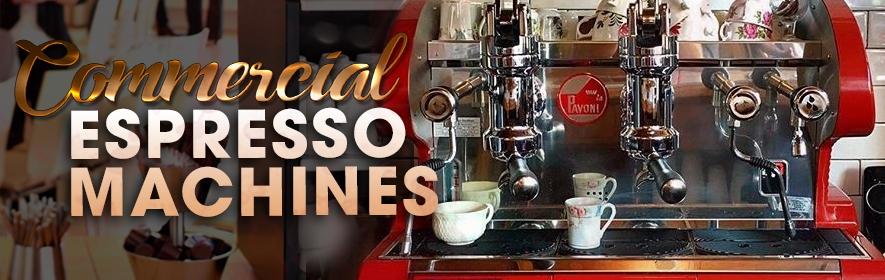
We carry traditional multi-group machines from Rancilio of Italy and super-automatic bean-to-cup machines from Jura of Switzerland and Egro (both part of the Rancilio Group).
Are you outfitting a new café bar, workplace breakroom, or coffee cart? 1st in Coffee can match a machine to your volume and service style.
Call 800-709-8210, seven days a week.
Shipping: Commercial machines from Rancilio ship directly from the manufacturer and include factory-coordinated installation and warranty.

Not sure where to start? 1st in Coffee offers a range of machines suitable for the most common commercial situations. Every machine below is sourced from trusted suppliers and backed by manufacturer support.
1st in Coffee carries three families of commercial espresso machines. The right one depends on whether you want full barista control, push-button automation, or traditional lever craft.
Traditional commercial espresso machines are the standard behind most café bars. A barista grinds, doses, and tamps, then the machine pulls the shot. Either started and stopped by hand (semi-automatic, e.g., the Rancilio Classe 5 S) or dosed automatically by programmed volume (auto-volumetric, e.g., the Rancilio Classe 5 USB, Classe 7 USB, and Classe 9 USB).
Volumetric dosing keeps shots consistent across multiple baristas during a rush. At 1st in Coffee, these machines come in 1-, 2-, 3-, and 4-group configurations and plum into a water line for continuous service.
Best for: cafés, restaurants, and any venue where a barista is pulling shots to order.
Shop traditional commercial espresso machines
A commercial super-automatic (bean-to-cup) machine grinds, doses, brews, and froths at the touch of a button. No barista required.
1st in Coffee carries Swiss Jura professional machines (Jura X10 not , GIGA X8 Professional, WB ?, X10) and Egro / Rancilio Ergo One high-volume machines. Egro, part of the Rancilio Group, invented the first super-automatic espresso machine in 1972, and today’s high-volume models produce up to 250 espresso shots per hour.
Super-automatics shine in offices, hotels, breakrooms, self-serve counters, and convenience stores where there’s no trained barista and consistency matters.
Best for: push-button consistency in staff-light or self-service settings.
Shop super automatic commercial machines
Group count is the single most important commercial sizing decision. It sets how many shots you can pull at once and caps your peak throughput. Match it to your busiest hour, not your daily total. 1st in Coffee carries traditional Rancilio machines in 1-, 2-, 3-, and 4-group configurations.
|
Group count |
Drinks per hour (peak) |
Drinks per day |
Best venue |
Example model |
|
1-group |
up to ~30 |
up to ~50 |
Kiosk, office, coffee cart, small café |
Rancilio Classe 5 (compact) |
|
2-group |
~60–120 |
~150–200 |
Most independent cafés & restaurants |
Rancilio Classe 7, Classe 9 (2-group) |
|
3-group |
~120–180+ |
300–400+ |
High-volume café, drive-thru, multi-barista bar |
Rancilio Classe 9 (3-group) |
|
4-group |
~180+ |
400+ |
Very high-volume / large operations |
Rancilio Classe 9 (4-group) |
|
Super-automatic |
up to ~250 shots |
all-day self-serve |
Office, hotel, convenience store, self-serve |
Rancilio Ergo One / Egro One |
Real-world throughput depends on barista skill, drink mix (straight espresso is faster than milk drinks), and your grinder. Treat these as planning ranges and size up if you’re on the line.
A 1-group commercial machine pulls one or two shots at a time. It’s the right size for low-volume cafés, kiosks, offices, coffee carts, and tasting bars, with roughly 30 drinks per hour at peak or around 50 drinks a day.
Compact options like the Rancilio Classe 5 (compact 5L boiler) fit tight counters and mobile setups while keeping commercial-grade durability.
Best for: carts, kiosks, offices, and small cafés.
Shop 1-group commercial espresso machines
A 2-group machine is the workhorse of most independent cafés, handling roughly 60–120 drinks per hour at peak (about 150–200 a day) and letting two baristas pull shots in parallel during a rush.
The Rancilio Classe 5, Classe 7, Classe 9, and Invicta are all available as 2-group machines with 11L boilers.
Best for: the majority of cafés, restaurants, and busy offices.
Shop 2-group commercial espresso machines
A 3-group machine is built for high-volume venues like busy specialty cafés and drive-thrus requiring large operations. They push roughly 120–180+ drinks per hour at peak, where a 2-group would bottleneck.
The Rancilio Classe 5, Classe 7, and Classe 9 are offered in 3-group versions with 16L boilers and 6,000-watt heating for rapid recovery (4-group versions with 22L boilers are also available).
Best for: high-traffic cafés and multi-barista bars.
Shop 3-group commercial espresso machines
The boiler system drives temperature stability, how well the machine handles back-to-back drinks, and price. Here are the configurations used across the 1st in Coffee commercial range.
A heat exchanger (HX) machine maintains one boiler at steam temperature and heats fresh brew water on demand via a circuit that runs through it. This lets you brew and steam simultaneously.
Rancilio’s single-boiler Steady Brew machines (Invicta, Classe 5, Classe 7) build on this approach with stable extraction temperature and per-group T-Switch control.
HX is a practical, cost-effective choice for independent cafés with moderate to busy volume.
Best for: most independent cafés balancing performance and cost.
Shop heat exchanger commercial machines
A dual boiler machine uses separate boilers for brewing and steaming. Each of these are independently temperature-controlled for higher shot-to-shot consistency and faster recovery between drinks.
This setup is the configuration speciality cafés reach for when extraction precision is central to the menu.
Best for: specialty cafés where shot consistency is the priority.
Shop dual boiler commercial machines
A multi-boiler machine gives each group head its own dedicated boiler. It delivers maximum temperature stability across every group, even at full tilt.
It’s the top tier for high-volume, multi-barista bars where each group needs to hold its temperature independently.
Best for: high-end, high-volume operations that demand per-group precision.
Shop multi-boiler commercial machines
Different venues have different priorities. Volume, footprint, whether a trained barista is on staff, and whether you can plumb in a water line are all important considerations. Here’s where 1st in Coffee suggests starting by setting it.
A traditional 2- or 3-group volumetric machine (Rancilio Classe 5, 7, or 9) is the standard for a café or restaurant with a barista pulling shots to order.
A 2-group covers most independent cafés (~60–120 drinks/hour at peak) while a 3-group (~120–180+ drinks/hour) is good for high-traffic bars.
Volumetric dosing keeps shots consistent across staff, and the group count must match your busiest hours.
Best for: front-of-house barista service.
Café & restaurant espresso machines
For an office or breakroom, a super-automatic bean-to-cup machine like the Jura GIGA X8 Professional or Jura X8 is a good fit. It lets employees and guests make café drinks at the touch of a button without a barista or training.
The automatic rinse/clean cycles keep maintenance low as well.
Best for: staff-light workplaces and client-facing breakrooms.
Office espresso machines
Have a coffee cart, trailer, or catering setup where plumbing isn’t available? Go with a water tank / pour-over machine like the Rancilio Classe 5 S TANK, or a compact 1-group.
These run without a fixed water line while keeping commercial durability and output.
Best for: mobile, catering, and pop-up service.
Coffee cart & mobile espresso machines
For convenience stores, hotels, and self-serve counters, a high-volume super-automatic such as the Rancilio Ergo One or Egro One (up to 250 shots per hour) with an automatic milk system delivers consistent drinks all day with no operator.
Best for: unattended, high-throughput self-service.
Self-serve & convenience store machines
Buying a commercial espresso machine? These three decisions will help you pick the right machine. Get these right before you shortlist models, and the 1st in Coffee team can walk through them with you.
Size the machine to your peak hour, not just your daily total, because that’s where bottlenecks happen.
High-volume super-automatics like the Rancilio Ergo One reach up to 250 shots per hour for unattended self-serve. If you’re between sizes, size up. Running a machine at its ceiling every day shortens its life.
A heat exchanger uses one steam boiler plus an on-demand brew circuit so you can brew and steam at once. It’s a practical, cost-effective choice for moderate-to-busy cafés (Rancilio’s Steady Brew single-boiler machines fall into this category).
A dual boiler separates brewing and steaming into independently controlled boilers for higher shot-to-shot consistency and faster recovery. That’s the specialty-café standard.
A multi-boiler provides each group with its own boiler, ensuring maximum stability at scale. The top tier for high-volume, multi-barista bars.
Choose based on how central extraction precision is to your menu and how heavy your volume is.
Most traditional commercial machines are plumbed directly into a water line and need a drain. Rancilio Classe machines, for example, require a dedicated cold-water line with a 3/8" NPT fitting and shut-off valve within ~4 feet, plus an open gravity drain (min. 2" I.D.) within ~4 feet.
However, the electrical demand is high. 2 and 3-group machines draw 3,000–6,000 watts, which typically means a dedicated 220–240V circuit (a compact 1-group or water-tank model may run on 110V; confirm per model).
A water softener/filter is required to protect the boiler and hold the warranty. Rancilio specifies water hardness of 2–3 GPG. Look for NSF/ETL certification where local health codes require it. Plan these utilities before your machine arrives, and our team can spec them with you.
A commercial machine is only as good as the grinder feeding it. A high-volume café needs a commercial grinder that holds calibration and doses consistently through a rush, and water filtration isn’t optional (it protects the boiler, preserves flavor, and is usually a warranty condition).
Budget for a matched commercial grinder and a filtration/softening system alongside the machine. Our team can spec a complete bar setup, including a machine, grinder, and filtration, to match your volume.
The purchase price is only part of a commercial machine’s cost. Daily upkeep, consumables, and uptime matter just as much over a machine’s life. Planning for them keeps shots consistent and prevents lost revenue from a machine that’s down during a rush. 1st in Coffee supports the machines it sells with parts and service.
1st in Coffee focuses on proven commercial manufacturers rather than stocking everything.
Italian — traditional & high-volume:
Swiss & automated — bean-to-cup:
Browse all espresso machine brands
A commercial espresso machine is a hefty investment. 1st in Coffee supports it beyond checkout:
Buying new gets you the latest models, a full manufacturer's warranty, and factory installation. For most cafés and offices, the best choice is to invest for the long term.
Refurbished/renewed commercial machines can lower the entry cost for a startup café, a second location, or a backup machine, and 1st in Coffee’s refurbished equipment comes with a warranty.
If you’re weighing the two, the deciding factors are budget, how central the machine is to daily revenue, and how long you plan to run it. Our team can tell you what refurbished machines are currently available and help you compare their total cost of ownership.
Shop refurbished commercial machines
The best commercial espresso machine is the one that matches your daily volume, service style, and whether a trained barista is on staff. For a barista-run café or restaurant, a 2- or 3-group traditional volumetric machine, like the Rancilio Classe 7 or Classe 9, covers most needs.
For an office, hotel, or self-serve counter with no barista, a super-automatic like the Jura GIGA X8 Professional or the high-volume Rancilio Ergo One is the better fit.
There’s no single “best” option. The one that matches your group count to your peak hour would do wonders for you. Our team at 1st in Coffee can recommend a specific model for your cup count and venue.
Commercial espresso machines generally range from about $2,000 for an entry single-group traditional machine to roughly $26,000 for a high-volume flagship or multi-group super-automatic.
At 1st in Coffee, traditional Rancilio Classe machines typically run from the mid-$4,000s for a 2-group up to the $20,000s for larger configurations, while professional super-automatics like the Jura GIGA X8 Professional are around $10,000.
Refurbished machines and financing through 1st in Coffee can lower the upfront cost. Pricing varies by group count, boiler type, and configuration. Contact us for a quote.
Count the group's size by your busiest hour, not your daily total. As a guide, a 1-group machine handles up to about 30 drinks per hour (roughly 50 per day).
A 2-group machine covers most independent cafés at about 60–120 drinks per hour (150–200 per day), and a 3-group machine handles 120–180+ drinks per hour (300–400+ per day) for high-volume venues or any bar where a 2-group would bottleneck.
High-volume super-automatics reach up to 250 shots per hour for self-serve. Throughput depends on barista skill, drink mix, and grinder, so treat these as planning ranges. If you’re between sizes, size up.
A heat exchanger machine uses a single steam boiler with an on-demand brew-water circuit, letting you brew and steam simultaneously at a lower cost. A practical choice for moderate-to-busy cafés.
A dual boiler machine uses separate, independently controlled boilers for brewing and steaming, giving higher shot-to-shot consistency and faster recovery. That’s the specialty-café standard.
A multi-boiler machine gives each group head its own boiler, ensuring maximum temperature stability across all groups at high volume.
In short: heat exchanger for value, dual boiler for precision, multi-boiler for precision at scale.
Yes. Most traditional commercial machines are plumbed into a dedicated cold-water line (commonly a 3/8" NPT fitting with a shut-off valve nearby) and need an open gravity drain.
Electrically, 2 and 3-group machines draw 3,000–6,000 watts and usually require a dedicated 220–240V circuit, while a compact 1-group or water-tank model may run on 110V.
A water softener/filter is also required to protect the boiler and maintain the warranty (Rancilio specifies a water hardness of 2–3 GPG). For mobile or cart use, choose a water tank/pour-over model that doesn’t require a plumbed line.
Daily maintenance is essential for consistent shots and long machine life. Each day, backflush the group heads with a blind filter and detergent, purge and wipe the steam wands after every milk drink, empty and rinse the drip tray, and clean portafilters and baskets regularly.
A dedicated water softener/filter prevents scale (Rancilio specifies 2–3 GPG water hardness), and the machine should be descaled according to your water quality.
Plan for periodic preventive maintenance. Replace gaskets, screens, and seals before they fail to avoid downtime. Rancilio commercial machines purchased through 1st in Coffee include a year of manufacturer-coordinated preventive maintenance service.
Join 1st in Coffee’s mailing list
and we’ll keep in touch with new products and special offers