You could win a pound of Kona Coffee!
Be the first to know about new products and special promotions.

Checkout using your account
This form is protected by reCAPTCHA - the Google Privacy Policy and Terms of Service apply.
Checkout as a new customer
Creating an account has many benefits:
Definition, Brewing & How It Differs From Coffee
Last updated: May 2026 · Written by the coffee team at 1st in Coffee
Most people assume espresso is a kind of bean. Or maybe a dark roast. Something that lives in a special bag with Italian writing on it. That assumption is wrong, and it's responsible for most of the confusion around espresso. It's not a bean, it's not a roast, and it's not a blend with a secret recipe. It's a method. A brewing method. That's it. Once you actually let that land, the rest of the picture clarifies pretty quickly.
QUICK ANSWER
Espresso is a concentrated coffee beverage brewed by forcing hot water through finely ground coffee at roughly 9 bar of pressure, producing a small 1–2 oz shot topped with a layer of crema. The key thing to understand is that espresso is a brewing method, not a special bean, blend, or roast. That's why it's the base for most café drinks, from lattes and cappuccinos to macchiatos and americanos.
The name is Italian. It comes from the full term "caffè espresso," meaning "pressed-out coffee," rooted in the verb "esprimere" ("to press out"), which itself traces back to the Latin "exprimere." That etymology fits perfectly: hot water physically forced under pressure through a compact bed of ground coffee.
But there's a second meaning, and it's just as fitting. In Italian, espresso also describes something made expressly for you, on the spot, to order. When the term was coined around 1900, both ideas came bundled together: coffee that's pressed out and made right then, just for you. The name points to the method and the moment. Not the bean. Never the bean.
One small note worth making: the correct spelling is "espresso," not "expresso." Common misspelling, even among people who drink it daily.
Same two ingredients. Ground coffee and water. That's where the similarity ends.
Espresso relies on high pressure and a very fine grind to pull a small, concentrated shot in under 30 seconds. Drip coffee does the opposite, letting hot water pass slowly through a coarser grind under gravity, filling a much larger cup over several minutes. The brewing ratio tells the story clearly. Espresso runs around 1:2 grounds to water. Drip sits closer to 1:15–1:18, the "golden ratio" range the Specialty Coffee Association defines. That's why espresso comes out thick and syrupy with crema on top while drip comes out thin and clean.
Strength is where people get confused. Espresso packs more caffeine per ounce. But a full mug of drip coffee usually delivers more total caffeine, simply because of volume. So "espresso is stronger" is accurate by concentration and quietly misleading by the cup.
|
Factor |
Espresso |
Regular (drip) coffee |
|
Brewing |
Pressure (≈9 bar) |
Gravity / steeping |
|
Grind |
Very fine |
Medium–coarse |
|
Brew time |
25–30 seconds |
4–6 minutes |
|
Ratio (grounds:water) |
~1:2 |
~1:15–1:18 |
|
Serving size |
1–2 oz |
8–12 oz |
|
Texture |
Thick, with crema |
Thin, clear |
This is where most of the confusion lives. Espresso is defined by how it's brewed, not by a particular bean, blend, or roast. Here's the truth behind each myth.
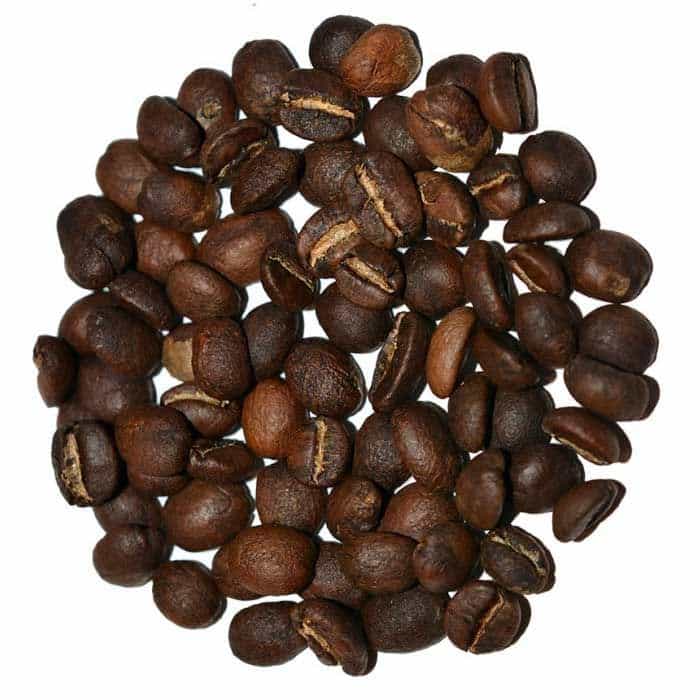
No. There's no such thing as a separate espresso bean. Any type of coffee bean can make good espresso. Inaccurate marketing and word of mouth have convinced many people that the bean determines whether a brew counts as espresso. It doesn't. Beans labeled "espresso" are simply beans a roaster has chosen to roast in a style that suits espresso, usually darker, but that's a roasting decision. Not a different kind of coffee.
No. Blends designed specifically for espresso exist, and a great one certainly helps, but the blend doesn't make it espresso. The long pursuit of the perfect espresso blend is exactly what created this misconception. Some roasters will even argue you can only make good espresso with the right blend. The brewing method is what defines it. (1st in Coffee carries espresso blends from illy, Lavazza, and Segafredo, and we even have our own house espresso blend.)
An espresso roast is a style, not a requirement, and it's far more flexible than most people think. Popular belief says espresso must be a very dark roast. But the preferred roast varies by region. In California, you're most likely to see a dark or "French" roast. On the East Coast, a lighter roast is often preferred. In Northern Italy, medium roast is generally the go-to. Light, medium, medium-dark, or dark roast can produce good espresso. It's entirely a matter of taste. Modern specialty roasters increasingly pull excellent shots from lighter, single-origin beans too.
No, and this distinction matters. Plenty of machines are labeled "espresso machines" without actually being ones. These are generally electric moka-style machines that rely on steam pressure to push water through the grounds. Steam pressure tops out at around 1.5 bar (50 PSI). Nowhere near enough.
A true espresso machine must produce a minimum of 9 bar (135 PSI) to force water through a tamped puck of finely ground coffee. Steam-driven moka pots are often sold in department stores for $75 or less and usually include a 4-cup carafe. True espresso machines, by contrast, are pump-driven or lever-operated. If a machine relies on steam pressure alone, it isn't making real espresso, no matter what the box says.
Espresso is a small 1 to 2 oz shot of pressure-brewed coffee. A single shot requires between 6.5 and 7.5 grams (about 1 tablespoon) of finely ground coffee, while a double requires roughly 16–20 grams. Brewing takes about 25 to 30 seconds, with water at around 90–96°C (195–205°F), the same temperature range the Specialty Coffee Association recommends for brewed coffee, forced through the grounds at 9 bar or more. The grounds sit in the portafilter, get pressed flat with a tamp, and then the water passes through the group head. The act of brewing a shot is called "pulling a shot," a phrase that survives from the early lever machines you physically pulled to build pressure.
|
Parameter |
Single shot |
Double shot |
|
Ground coffee |
6.5–7.5 g |
16–20 g |
|
Yield |
~1 oz (30 ml) |
~2 oz (60 ml) |
|
Pressure |
9 bar / 135 PSI |
9 bar / 135 PSI |
|
Extraction time |
25–30 sec |
25–30 sec |
|
Grind size |
Fine (table salt) |
Fine (table salt) |
Making a great espresso is an art as much as a science, and so is drinking one. In an Italian café, you might watch patrons breathe in the aroma while holding the cup and saucer, then drink the whole thing in three or four quick sips before setting it firmly back down. Adding sugar is an accepted practice in Italy; there is no shame in it. But a truly great espresso is worth drinking without additives, so you can taste and appreciate it fully.
Properly brewed, an espresso is finished with a layer of rich, dark-golden foam called crema. It forms when the natural oils in the coffee emulsify with carbon dioxide, a gas trapped in the beans during roasting, and get forced to the surface under pressure.
Crema is often described as a sign of quality, and it does loosely track freshness: fresh, properly stored beans produce more of it. But it's worth being honest here. Crema is not a reliable indicator of how the espresso will taste. It's entirely possible to pull a thick, beautiful crema on top of a shot that tastes terrible. Treat crema as a clue about freshness and extraction, not as proof of a great cup. Trust your palate over the foam. If you find the crema unpleasant on its own, try stirring it back into the shot; the sugars in the liquid below combine with it to create a more complex, balanced drink.
The core of espresso is, of course, the coffee bean, the seed from the heart of the coffee berry. These berries grow on trees that thrive in tropical climates at elevations between 2,000 and 6,000 feet above sea level. Berries are hand-picked or mechanically picked. Hand-picked is nearly always better, since it allows for more careful quality control, which is one reason premium beans cost more. There are two beans in each berry, and coffee is shipped in this unroasted, or "green," state, where it can be kept for much longer than roasted beans, up to two years under the right conditions.
All coffee is eventually roasted. Really good coffee is roasted just before brewing, because the average shelf life of roasted beans is only about two weeks. After that, quality drops quickly and flavor fades fast.
Roasting is an art with a firm basis in science. Beans are roasted in rotating drums at roughly 450°F for 10 to 20 minutes, with time and temperature adjusted to suit the roaster's preference and machine, an adjustment known as the roasting profile. After roasting, the beans rest for 12 to 36 hours to degas and release the gases produced during roasting. Roasted coffee beans contain around 1,500 chemical compounds that interact to create flavor, which is how a seemingly simple drink turns out to be genuinely complex.
Espresso has been around for quite a while. Luigi Bezzera patented the first steam-driven espresso machine in 1901, calling his creation the Tipo Gigante. In 1905, Desiderio Pavoni bought Bezzera's patent and brought it to market as the Pavoni Ideale. These early machines worked much like the modern moka-style brewer.
By 2000, espresso machines had advanced to the point where a real cappuccino could be made at the touch of a button. Some of the 1st in Coffee's most popular machines include the Jura E8, the Rancilio Silvia, and the one-touch Jura GIGA 10.
Espresso is the base for most of the café menu. Once you have a shot, you can build:
A single shot contains roughly 63 mg of caffeine. Concentrated per ounce, yes, but a full mug of drip coffee (around 95 mg) often wins on total caffeine just because there's so much more liquid in the cup.
A single uses about 6.5–7.5 g of coffee and yields roughly 1 oz. A double uses about 16–20 g and yields roughly 2 oz. Most cafés default to doubles, so if you didn't ask, that's probably what you got.
Any bean works. What makes it espresso is the pressurized brewing method, full stop. The bean type doesn't change that. Grind size and roast level shape the flavor, but origin doesn't decide whether it counts.
Not exactly. They often overlap, but "espresso roast" just means a roaster has dialed in those beans for espresso, usually landing somewhere medium-dark to dark. There's no fixed industry standard for it, and honestly, any roast level can pull a solid shot.
That layer is crema. It forms when coffee oils emulsify with carbon dioxide and get pushed to the surface under pressure. Fresh beans and proper extraction produce more of it, though a beautiful crema doesn't automatically mean the shot tastes good.
Stronger per ounce, yes. But a full cup of drip coffee often delivers more total caffeine simply because of the volume. So the answer really depends on what you mean by "stronger."
It's just the act of brewing espresso. The phrase stuck around from early lever machines, where the barista physically pulled a handle down to generate the pressure needed to brew.
However you take it, espresso always comes back to the same idea: it's a method, not a mystery bean. Master the pressure, grind, and dose, and the rest of the coffee menu opens up.
Join 1st in Coffee’s mailing list
and we’ll keep in touch with new products and special offers