You could win a pound of Kona Coffee!
Be the first to know about new products and special promotions.

Checkout using your account
This form is protected by reCAPTCHA - the Google Privacy Policy and Terms of Service apply.
Checkout as a new customer
Creating an account has many benefits:
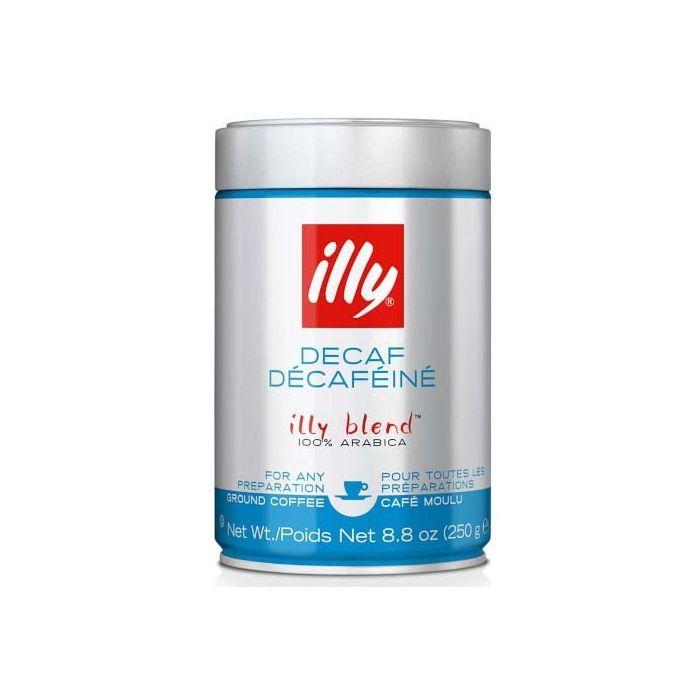

Fine Grind, illy decaf espresso coffee, perhaps the perfect espresso blend. 100% Arabica illy decaf ground coffee. Six 8.8 oz. cans of decaffeinated espresso per case.
Call Us for Expert Advice! 800-709-8210
More About Illy Fine Grind Decaf coffee
For many, coffee without caffeine is a pointless exercise. Caffeine, which acts on the prefrontal cortex, increases alertness and improves short-term memory. Each person has their own threshold for caffeine—the point where it ceases to be pleasant and gives us the jitters. People who enjoy coffee in the morning may eschew it in the evening. And there are others who enjoy a cup of coffee, hold the caffeine please.
"In creating our decaffeinated illy coffee, we wanted to keep the complex aromas that illy is known for," says Dr. Ernesto Illy. "After careful research, we selected our decaffeinating process based on its superior conservation of aromas and full, pleasant taste in the decaf. In blind tastings, many professional tasters picked illy decaf as their first choice for aroma and taste—even beating our regular (caffeinated) coffee. That is because inherently caffeine has a slight bitterness to it, so when you decaffeinate coffee properly, it tastes slightly sweeter. If you can also capture the same complex aromas—you have a truly wonderful cup of coffee—if you don't miss the caffeine."
A Short History of Decaffeination
Dr. Ludwig Roselius and Dr. Karl Wimmer invented the process of removing caffeine from coffee in Bremen, Germany as described in a patent letter dated from 1905. By 1912 the first decaffeinating plant was opened in the United States.
In order for a coffee to be designated as "decaffeinated" the caffeine content must be lower than 0.10% according to the European Standard
There are several methods of making decaffeinated espresso and coffee: Methylene Chloride, Ethyl Acetate, and Water Process
illycaffè's method of choice - Carbon Dioxide
This process is technically known as supercritical fluid extraction. In the carbon dioxide method for decaffeinating espresso, the caffeine is stripped directly from the beans by a highly compressed semi-liquid form of carbon dioxide. Pre-steamed beans are soaked in a bath of supercritical carbon dioxide at a pressure of 73 to 300 atmospheres. After a thorough soaking for around ten hours, the pressure is reduced, allowing the CO2 to evaporate, or the pressurized CO2 is run through either water or charcoal filters to remove the caffeine. The carbon dioxide is then used on another batch of beans. This liquid works better than water because it is kept in supercritical state near the transition from liquid to gas, combining favorable diffusivity properties of the gas with increased density of a liquid. This process has the advantage that it avoids the use of potentially harmful substances.
The extracted caffeine is purified and sold to pharmaceutical firms, soft drink companies and other businesses that add caffeine to their products.
The USFDA (United States Food and Drug Administration) allows a residual Methylene chloride content of 10 parts per million. However, after roasting not even these trace levels are detectable in the bean. The Methylene chloride dissipates at a much lower temperature (approx 120° Fahrenheit) than the coffee is roasted at (approx.428° Fahrenheit).
Other decaffeinating methods include methylene chloride, ethyl acetate and water process. Illycaffè does not use the water process because water processed coffees generally produce a less flavorful and flatter bodied cup of coffee. This process uses warm water under pressure to extract caffeine. The water is heated, 70-100° Celsius (120 to 160° Fahrenheit) and circulated until 94% to 96% of the caffeine is removed. In some cases the water is put through carbon filtration to remove the caffeine. Since caffeine is not the only substance in coffee that is soluble, important flavor components are also affected.
Coffee and caffeine have been the subject of extensive scientific research in the last 25 years. Some 1500 to 2000 papers per year have been published and we can assume that there are few products that we consume that have been so thoroughly and deeply studied. New research has shown that caffeine has many positive effects on the body—from improving concentration to fighting depression and reducing the risk of gallstones. But for the country's 107 million coffee drinkers, coffee is a pleasure, not a medicine, and for those who want a break from caffeine, illy provides the best tasting decaffeinated espresso available. Enjoy illy decaf espresso coffee from 1st in Coffee.
More About Illy Fine Grind Decaf coffee
For many, coffee without caffeine is a pointless exercise. Caffeine, which acts on the prefrontal cortex, increases alertness and improves short-term memory. Each person has their own threshold for caffeine—the point where it ceases to be pleasant and gives us the jitters. People who enjoy coffee in the morning may eschew it in the evening. And there are others who enjoy a cup of coffee, hold the caffeine please.
"In creating our decaffeinated illy coffee, we wanted to keep the complex aromas that illy is known for," says Dr. Ernesto Illy. "After careful research, we selected our decaffeinating process based on its superior conservation of aromas and full, pleasant taste in the decaf. In blind tastings, many professional tasters picked illy decaf as their first choice for aroma and taste—even beating our regular (caffeinated) coffee. That is because inherently caffeine has a slight bitterness to it, so when you decaffeinate coffee properly, it tastes slightly sweeter. If you can also capture the same complex aromas—you have a truly wonderful cup of coffee—if you don't miss the caffeine."
A Short History of Decaffeination
Dr. Ludwig Roselius and Dr. Karl Wimmer invented the process of removing caffeine from coffee in Bremen, Germany as described in a patent letter dated from 1905. By 1912 the first decaffeinating plant was opened in the United States.
In order for a coffee to be designated as "decaffeinated" the caffeine content must be lower than 0.10% according to the European Standard
There are several methods of making decaffeinated espresso and coffee: Methylene Chloride, Ethyl Acetate, and Water Process
illycaffè's method of choice - Carbon Dioxide
This process is technically known as supercritical fluid extraction. In the carbon dioxide method for decaffeinating espresso, the caffeine is stripped directly from the beans by a highly compressed semi-liquid form of carbon dioxide. Pre-steamed beans are soaked in a bath of supercritical carbon dioxide at a pressure of 73 to 300 atmospheres. After a thorough soaking for around ten hours, the pressure is reduced, allowing the CO2 to evaporate, or the pressurized CO2 is run through either water or charcoal filters to remove the caffeine. The carbon dioxide is then used on another batch of beans. This liquid works better than water because it is kept in supercritical state near the transition from liquid to gas, combining favorable diffusivity properties of the gas with increased density of a liquid. This process has the advantage that it avoids the use of potentially harmful substances.
The extracted caffeine is purified and sold to pharmaceutical firms, soft drink companies and other businesses that add caffeine to their products.
The USFDA (United States Food and Drug Administration) allows a residual Methylene chloride content of 10 parts per million. However, after roasting not even these trace levels are detectable in the bean. The Methylene chloride dissipates at a much lower temperature (approx 120° Fahrenheit) than the coffee is roasted at (approx.428° Fahrenheit).
Other decaffeinating methods include methylene chloride, ethyl acetate and water process. Illycaffè does not use the water process because water processed coffees generally produce a less flavorful and flatter bodied cup of coffee. This process uses warm water under pressure to extract caffeine. The water is heated, 70-100° Celsius (120 to 160° Fahrenheit) and circulated until 94% to 96% of the caffeine is removed. In some cases the water is put through carbon filtration to remove the caffeine. Since caffeine is not the only substance in coffee that is soluble, important flavor components are also affected.
Coffee and caffeine have been the subject of extensive scientific research in the last 25 years. Some 1500 to 2000 papers per year have been published and we can assume that there are few products that we consume that have been so thoroughly and deeply studied. New research has shown that caffeine has many positive effects on the body—from improving concentration to fighting depression and reducing the risk of gallstones. But for the country's 107 million coffee drinkers, coffee is a pleasure, not a medicine, and for those who want a break from caffeine, illy provides the best tasting decaffeinated espresso available. Enjoy illy decaf espresso coffee from 1st in Coffee.
Join 1st in Coffee’s mailing list
and we’ll keep in touch with new products and special offers